
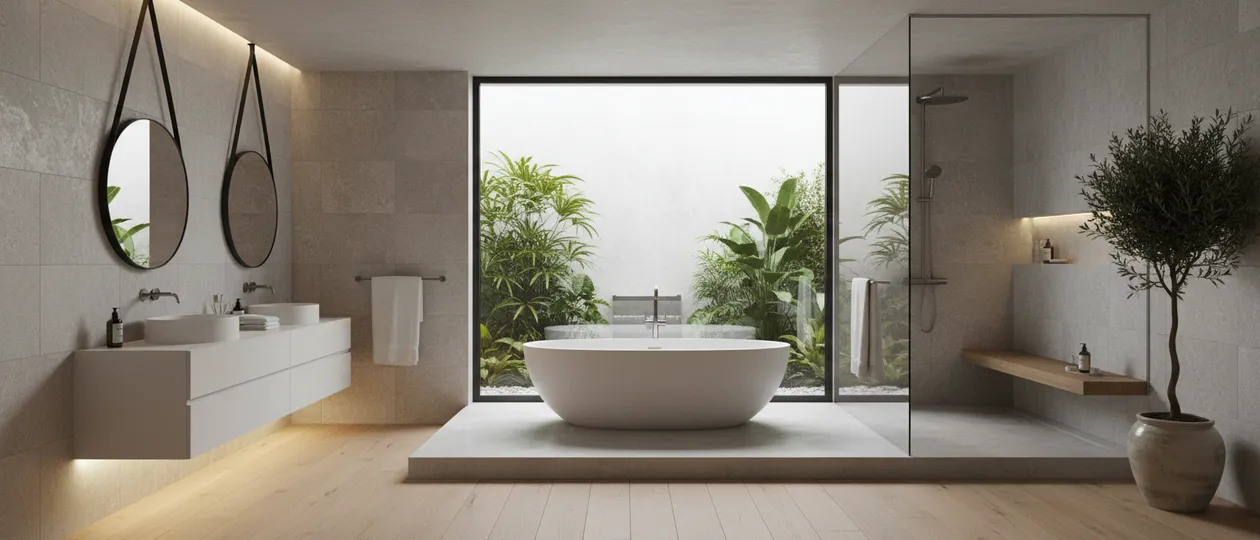
A bathroom renovation is one of the highest-impact upgrades you can make to your home. A well-designed bathroom improves your daily routine, increases your property’s value, and lasts 15 to 20 years before it needs attention again. It’s also one of the trickiest rooms to get right — plumbing, waterproofing, electrical work, and ventilation all converge in what is often the smallest room in the house.
This guide walks you through every stage, from defining your scope of work to avoiding the mistakes that catch most first-time renovators off guard.
Defining your bathroom renovation scope
Before you look at tiles or tap/faucet finishes, get clear on the type of renovation you’re undertaking. The scope determines your budget, your timeline, and whether you’ll need professional tradespeople or can handle parts yourself.
Levels of bathroom renovation
Cosmetic refresh ($2,000-$8,000)
- New paint or wall panels over existing surfaces
- Replacement taps/faucets and showerhead
- New mirror, lighting fixtures, and accessories
- Replacement toilet seat and bath panel
- Re-grouting or re-caulking existing tiles
A cosmetic refresh works when the layout is functional, the plumbing is sound, and the waterproofing is intact.
Mid-range remodel ($8,000-$25,000)
- New tiles on floors and walls
- Replacement bath, shower enclosure, or both
- New toilet and vanity unit
- Updated plumbing fixtures (same locations)
- New lighting with minor electrical changes
- New ventilation fan
- Fresh waterproofing in wet areas
This is the sweet spot for most homeowners — a bathroom that looks and feels new without the cost of moving plumbing.
Full renovation ($25,000-$60,000+)
- Complete layout change (moving fixtures to new positions)
- Plumbing rerouted to accommodate new layout
- New electrical throughout (heated floors, towel rails, recessed lighting)
- Structural work (moving walls, enlarging the room, adding a window)
- Premium materials: natural stone, frameless glass, custom vanity
- Underfloor heating
- Walk-in shower or wet room conversion
A full renovation makes sense when the existing layout doesn’t work or the plumbing is old. It requires a general contractor or specialist bathroom fitter to coordinate the trades.
Planning your bathroom layout
Layout is the single most important decision in a bathroom renovation. A beautiful bathroom with a bad layout is one you’ll hate using. Work out the layout before you choose a single tile.
Layout principles
Start with the drain locations. Moving a toilet drain is expensive — it requires breaking into the floor and re-routing the soil pipe. If you can work with existing drain positions, your budget goes further.
Maintain clearances. Building codes in most countries specify minimum clearances around fixtures:
- At least 380mm (15 inches) from the centre of the toilet to any side wall or obstruction
- At least 600mm (24 inches) of clear floor space in front of the toilet
- At least 600mm (24 inches) of clear floor space to exit a shower
- Door must open without hitting any fixture
Think about the daily routine. A family bathroom needs a bathtub. An ensuite for two adults benefits from a double vanity. A guest bathroom can be simpler.
Common bathroom layouts
Three-piece bathroom (toilet, sink, bath or shower)
The standard layout for most homes. Works in spaces as small as 3.5m2 (about 38 sq ft). Place the toilet against the shortest wall, the bath/shower along the longest wall, and the vanity between them.
Four-piece bathroom (toilet, sink, bath, and separate shower)
Requires at least 6.5m2 (about 70 sq ft). The separate shower and bath give you flexibility — a quick shower in the morning, a soak in the evening. Place the bath and shower on the same wall to simplify plumbing.
Wet room
The entire room is waterproofed and the shower drains directly into the floor. Works well in compact spaces because there’s no enclosure eating into the room. Requires careful waterproofing (called tanking in the UK) across every surface, including walls to at least 1.8m (6 ft) height.
Jack-and-Jill bathroom
Shared bathroom accessible from two bedrooms with a lock system that secures both entry doors. Good for children’s or guest bedrooms.
Choosing fixtures and fittings
Your fixtures determine the bathroom’s look, functionality, and longevity. Buy the best quality you can afford for the items that get the most use.
Toilets
Close-coupled: Tank sits directly on the bowl. Most common, easiest to install, and simplest to repair. Budget-friendly.
Wall-hung: Bowl mounted to the wall with a concealed cistern behind. Clean, modern look and easier floor cleaning, but more expensive to install.
Back-to-wall: Concealed cistern, but the bowl rests on the floor. A middle ground between the two.
Look for dual-flush mechanisms (6 litres / 1.6 gallons full flush, 3 litres / 0.8 gallons half flush) for water efficiency.
Showers
Electric shower: Heats water on demand from the cold supply. Independent of your hot water system, but adds a visible unit to the wall.
Mixer shower (thermostatic): Blends hot and cold water from your existing supply. More powerful flow than electric. Thermostatic valves maintain temperature even when someone runs a tap elsewhere — essential for safety.
Digital shower: Electronically controlled mixer with a remote panel. Precise temperature presets. Premium option.
Aim for at least 8-10 litres per minute flow rate for a satisfying shower. If your home has low water pressure, consider a pump or pressurised system before choosing your shower type.
Baths
Standard alcove bath: Fits between three walls. Most affordable and space-efficient.
Freestanding bath: A statement piece needing space on all sides. Requires floor-standing or wall-mounted taps and a standalone waste connection.
Shower-bath: Standard bath with a wider end for comfortable showering. Practical for family bathrooms needing both functions in one fixture.
Acrylic baths are lightweight, affordable, and warm to the touch. Steel is more durable with better heat retention but heavier. Cast iron is the premium option but very heavy — check your floor can handle it.
Vanity and basin
Wall-mounted vanity: Creates visual space underneath and simplifies floor cleaning. Needs solid wall mounting.
Floor-standing vanity: More storage, easier to install, hides plumbing effectively.
Countertop basin: Sits on top of the vanity surface. Visually striking but reduces counter space.
Undermount basin: Mounted beneath the counter for clean lines. Requires a compatible countertop material (stone or solid surface, not laminate).
Waterproofing: the most critical step
Waterproofing failures are the number one cause of bathroom renovation disasters. Water penetrating behind tiles causes mould, structural rot, and damage to rooms below. This is not a step to cut corners on.
Where waterproofing is needed
- Shower floor and walls to at least 1.8m (6 ft) above the shower floor, or to ceiling height in a wet room
- Bath surround to at least 300mm (12 inches) above the rim of the bath
- Floor in any bathroom on an upper storey (to protect the ceiling below)
- Entire room if converting to a wet room
Waterproofing methods
Liquid membrane (paint-on): Applied in two coats with a brush or roller. The most common method for domestic bathrooms. Flexible, bridges small cracks, and suitable for most substrates. Allow full curing time between coats (check manufacturer instructions — typically 4-24 hours).
Sheet membrane: A pre-formed waterproof sheet bonded to the substrate. Used on floors and in wet rooms. More labour-intensive to install but provides consistent thickness.
Tanking systems: A combination of primer, liquid membrane, tape for joints, and pre-formed corners. Specialist systems (like Schluter DITRA or similar) provide a complete waterproof barrier under tiles.
Waterproofing rules
- The waterproof layer goes on BEFORE tiles, not after. Grout is not waterproof.
- All joints between floors and walls need tape reinforcement.
- Around pipes and fixtures, use pre-formed collars or generous sealant.
- Let each coat cure fully before applying the next.
- Document the waterproofing with photos before tiling — you’ll need this if there’s ever a warranty claim.
Ventilation: preventing mould and moisture damage
Bathrooms generate enormous amounts of moisture. A single shower produces enough water vapour to cause problems if it can’t escape. Poor ventilation leads to mould on walls and ceilings, peeling paint, and deterioration of fixtures.
Ventilation requirements
Most building regulations require mechanical ventilation in bathrooms without an openable window. Even if you have a window, a fan is strongly recommended — you won’t open a window in the middle of winter.
Extraction rates:
- Bathroom with shower: minimum 54 m3/h (about 32 CFM)
- Bathroom with bath only: minimum 36 m3/h (about 21 CFM)
- Wet room: aim for the higher end of extraction rates
Types of bathroom fans
Axial fan (wall or ceiling mounted): The standard option. Affordable, easy to install, suitable for short duct runs. Choose a model with a timer overrun (15-20 minutes after you leave).
Centrifugal/inline fan: Mounted in the duct run (often in the loft/attic). More powerful, suitable for longer duct runs, and quieter in the bathroom.
Heat recovery ventilator (HRV): Recovers heat from extracted air to warm incoming fresh air. Energy-efficient but significantly more expensive.
Ventilation tips
- Always duct to the outside — never into a loft/attic space
- Use rigid ducting where possible (flexible ducting reduces airflow)
- Ensure the fan is rated for bathroom use (IPX4 or higher in wet zones)
- Connect to the light switch with a timer overrun, or use a humidity sensor
Electrical work and bathroom zones
Electrical regulations in bathrooms are strict because water and electricity are a dangerous combination. In most countries, bathrooms are divided into zones that determine what electrical equipment can be installed where.
Bathroom zones (typical)
| Zone | Area | What’s allowed |
|---|---|---|
| Zone 0 | Inside the bath or shower tray | Only SELV (Safety Extra Low Voltage, max 12V) equipment rated IPX7 |
| Zone 1 | Directly above the bath/shower to 2.25m from floor | Equipment rated minimum IPX4; showers, instantaneous water heaters |
| Zone 2 | 0.6m around Zone 1, and above Zone 1 to ceiling | Equipment rated minimum IPX4; light fittings, fans, shaver sockets |
| Outside zones | Beyond Zone 2 | Standard equipment allowed, but common sense applies |
Key electrical considerations
- Hire a qualified electrician for all bathroom electrical work — this is not a DIY job
- All circuits in the bathroom should be protected by a residual current device (RCD / GFCI)
- Shaver sockets must be transformer-isolated (in the UK) or GFCI-protected (in the US)
- Heated towel rails need a permanent connection (not a plug) if within zones 1 or 2
- Underfloor heating must be installed by a qualified professional and connected to an RCD/GFCI
Creating a realistic timeline
Bathroom renovations take longer than most people expect. A realistic timeline prevents frustration and helps you plan around living without a bathroom.
Typical timelines by scope
| Scope | Duration | Notes |
|---|---|---|
| Cosmetic refresh | 2-5 days | No plumbing or tiling changes |
| Mid-range remodel | 2-4 weeks | New tiles, fixtures, minor plumbing |
| Full renovation | 4-8 weeks | Layout change, structural work, full re-plumb |
Timeline breakdown for a mid-range remodel
- Strip-out (1-2 days): Remove old fixtures, tiles, and any damaged substrate
- First fix plumbing (1-2 days): Rough-in pipe work for new fixture positions
- First fix electrical (1 day): Run cables for lighting, fan, heated towel rail
- Waterproofing (2-3 days): Apply membrane coats with curing time between
- Tiling (3-5 days): Walls first, then floor. Large-format tiles take longer due to precision cutting
- Second fix plumbing (1-2 days): Install fixtures, connect waste pipes, fit taps/faucets
- Second fix electrical (1 day): Install light fittings, fan, switches
- Finishing (1-2 days): Silicone sealing, accessories, mirrors, final clean
What causes delays
- Tile delivery: Specialist tiles can take 2-6 weeks to arrive. Order before demolition begins.
- Waterproofing cure time: Rushing this step is never worth it.
- Discovery of hidden problems: Rot in the floor, old lead pipes, asbestos in adhesive. Budget time for the unexpected.
- Material shortages: Having backup tile or fixture choices avoids waiting if your first choice is out of stock.
If you only have one bathroom, discuss the sequence with your contractor — sometimes they can maintain a working toilet through most of the renovation.
Budgeting and cost management
Understanding where the money goes helps you make informed trade-offs. Labour typically accounts for 40-60% of a bathroom renovation budget.
Where the money goes
| Category | % of budget | Notes |
|---|---|---|
| Labour (plumbing, tiling, electrical) | 40-60% | Varies by region and scope |
| Tiles and waterproofing | 15-25% | Floor and wall tiles are a major cost |
| Fixtures (toilet, bath, shower, vanity) | 15-25% | Huge range — from budget to luxury |
| Electrical and ventilation | 5-10% | Fan, lighting, heated towel rail |
| Miscellaneous (adhesive, grout, silicone, accessories) | 5-10% | The small items add up |
Cost-saving strategies
Keep plumbing where it is. Moving a toilet drain alone can add $1,000-$3,000 to your budget. Invest the savings in better fixtures or finishes.
Spend on what you touch daily. Taps/faucets, showerheads, and flush mechanisms get used thousands of times a year. Cheap ones fail sooner. Spend more here, save on decorative items.
Use premium tiles strategically. Feature tiles on one accent wall or in the shower niche; more affordable tiles for the rest.
Don’t skimp on waterproofing. This is not a line item to reduce. A waterproofing failure can cost more to fix than the entire original renovation.
Get a detailed quotation. A proper quote should itemise labour, materials, and fixtures separately. This protects you from scope creep and makes it easier to manage change orders if you adjust the plan.
For a deeper look at budgeting strategies, see our renovation budget guide.
Common bathroom renovation mistakes
Learning from other people’s mistakes is cheaper than making your own. These are the issues that bathroom renovation professionals see repeatedly.
1. Inadequate waterproofing
The most expensive mistake. If water gets behind tiles, you won’t know until the damage is extensive. Insist on seeing the waterproofing before tiling begins, and photograph it.
2. Insufficient lighting
A single ceiling light leaves shadows on your face at the mirror — exactly where you need good light. Layer your lighting: ceiling downlights for general illumination, wall-mounted lights flanking the mirror for task lighting, and optionally a dimmer for ambient evening light.
3. Forgetting about storage
Plan storage into the design: a vanity with drawers, a recessed shower niche (built into the wall during tiling), a mirrored cabinet above the basin.
4. Choosing style over function
That vessel basin on a floating shelf looks stunning in photos. In practice, it splashes water everywhere and has no counter space. Always test practicality against daily use.
5. Not planning for the future
If household members may have mobility challenges later, consider grab bars (blocking walls during renovation makes retrofitting easier), a curbless shower entry, and lever-style taps/faucets.
6. Skipping the fan
Relying on a window for ventilation is a recipe for mould. Install a proper extraction fan, even if you have a window.
7. Tiling before finalising fixtures
Tiling first and then choosing fixtures results in awkward cuts around basins, misaligned patterns, and visible pipework. Finalise every fixture position before tiling starts.
Hiring the right professionals
A bathroom renovation involves multiple trades in a small space. Coordination matters as much as individual skill.
Who you need
- Plumber: First and second fix plumbing. Qualified and insured.
- Electrician: Certified for bathroom work (Part P in the UK, licensed in most US states).
- Tiler: Look at previous bathroom work specifically, not just general tiling.
- General contractor: Coordinates all trades and manages the schedule if you’d rather not do it yourself.
What to ask before hiring
- Can I see examples of similar bathroom projects you’ve completed?
- Who will actually do the work — you or a subcontractor?
- What does your quote include and exclude?
- How do you handle unexpected issues (hidden rot, old plumbing)?
- What’s your payment schedule?
For more on finding and vetting professionals, see our guide on how to find a reliable contractor.
Tying it all together: your bathroom renovation checklist
Use this checklist to stay on track through the process:
- Define scope and budget — Be realistic about what you can afford and what you need
- Design the layout — Work with existing drain positions if possible
- Choose fixtures — Finalise every item before work begins
- Get quotes — At least three detailed quotations from different contractors
- Order materials early — Tiles, fixtures, and fittings should be on-site before demolition
- Confirm waterproofing plan — Discuss method and products with your contractor
- Plan for disruption — Arrange an alternative bathroom if needed
- Monitor progress — Check waterproofing before tiling, check tile layout before grouting
- Final snagging — Walk through with the contractor and list anything that needs attention
- Enjoy it — A good bathroom renovation is one of the most satisfying home improvements you’ll make
If you’re planning a broader renovation beyond the bathroom, our how to plan a home renovation guide covers the full process from start to finish.
Ready to plan your bathroom renovation?
Aikitektly helps you describe your renovation project clearly and completely, so you can communicate confidently with contractors and get accurate quotes.
Join our early access programme and be among the first to use our AI-powered renovation planning tool.