
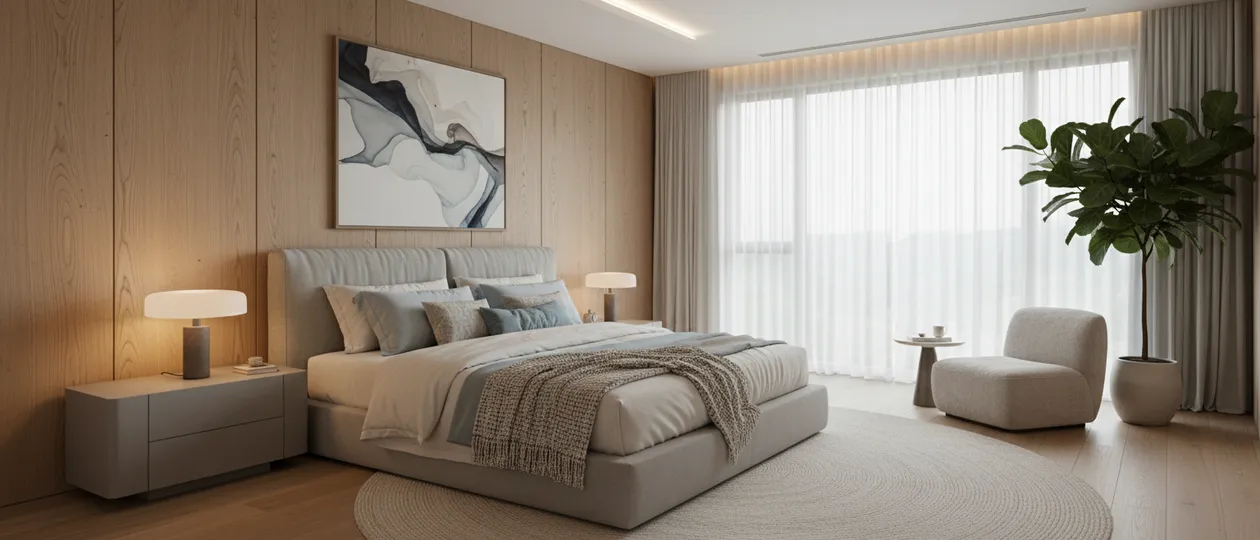
Your bedroom should be the most restful room in your home. In practice, it is often the room that gets the least renovation attention. Kitchens and bathrooms tend to dominate renovation budgets because they affect property value and daily function. But a poorly designed bedroom — one with inadequate storage, bad lighting, or an awkward layout — affects your sleep quality, your morning routine, and your overall wellbeing.
A bedroom renovation does not need to be expensive. Some of the highest-impact changes (better lighting, smarter storage, a considered layout) cost far less than a kitchen remodel. This guide covers everything from quick wins to major upgrades like adding an en-suite bathroom, and helps you build a clear scope of work so you can communicate your vision confidently to contractors.
Defining your bedroom renovation scope
As with any renovation, start by being honest about what your bedroom actually needs and what you can afford.
Levels of bedroom renovation
Cosmetic refresh ($1,500-$5,000)
- Fresh paint or a feature wall with wallpaper
- New curtains or blinds
- Updated lighting fixtures (bedside lamps, pendant)
- New bedding and soft furnishings
- Rearranged furniture or one key new piece
Mid-range remodel ($5,000-$20,000)
- New flooring
- Fitted wardrobes or a custom closet system
- Rewired lighting with dimmers and bedside switches
- New skirting boards/baseboards and door
- Replastered walls and fresh decoration
- Upgraded windows for better insulation or noise reduction
Full renovation ($20,000-$60,000+)
- Adding an en-suite bathroom
- Structural changes (reconfiguring room shape, adding a dormer)
- Complete rewiring and new lighting design
- Underfloor heating
- Custom built-in furniture and joinery
- New or enlarged windows
The key question is whether your bedroom needs cosmetic improvement or functional change. If the room is the right size, well-lit, and has enough storage, a cosmetic refresh may be all you need. If you are constantly frustrated by the layout, cannot find space for your clothes, or wake up cold because the windows are single-glazed, the investment in a deeper renovation pays for itself in daily comfort.
Layout optimisation
Bedroom layout is more constrained than living room layout because one piece of furniture — the bed — dominates the space. A king-size bed is approximately 1.5m x 2m (5’ x 6’6”), and it needs clearance on at least two sides. Getting the bed position right is the foundation of everything else.
Bed placement principles
Centre of the main wall. The most common and visually balanced option. Place the bed centred on the longest wall that does not have windows or the door. This leaves room for bedside tables on both sides.
Away from the door. In feng shui and general design principles, placing the bed so you can see the door from the bed (without being directly in line with it) creates a sense of security and calm.
Away from windows where possible. Beds directly under windows can feel draughty and make window treatment choices harder. If the room layout forces you under a window, ensure the window has good insulation and consider a low headboard.
Minimum clearances:
- 600mm (24”) on each side of the bed for walking and making the bed
- 900mm (36”) in front of wardrobe doors for opening them fully
- 750mm (30”) at the foot of the bed for walking past
Small bedroom strategies
If your bedroom is small (under 12m2/130 sq ft), every centimetre counts:
- Use the door wall. Storage or a desk can often fit on the same wall as the door, in the space beside and above the doorframe.
- Go vertical. Floor-to-ceiling wardrobes store more than standard height ones and look built-in rather than freestanding.
- Consider a platform bed with storage drawers built into the base. This recovers the dead space under the bed.
- Wall-mounted bedside shelves instead of bedside tables free up floor space and look clean.
- Mirrors on wardrobe doors or a wall visually double the space.
Multi-function bedrooms
Many bedrooms now serve double duty — as a workspace, a dressing room, or an exercise space. If your bedroom needs to accommodate more than sleeping:
- Define zones clearly. Use lighting, a rug, or furniture arrangement to separate the sleep area from the work or dressing area.
- Keep the bed area sacred. Position the desk so it is not the first thing you see from the bed. If the room is small, a fold-down desk or a console table that doubles as a workspace can disappear when not in use.
- Consider a walk-in wardrobe. If you have a spare adjacent room or a large bedroom, partitioning part of the room into a walk-in closet or dressing area can be more practical than fitted wardrobes. It also clears visual clutter from the sleep zone.
Wardrobe and closet solutions
Clothing storage is the single biggest functional challenge in most bedrooms. If you are renovating, this is the time to solve it properly.
Fitted wardrobes versus freestanding
Fitted wardrobes (built-in closets)
- Custom-designed to fit your exact space, including awkward alcoves, sloping ceilings, and chimney breast recesses
- Floor-to-ceiling designs maximise vertical storage
- Can include internal systems: hanging rails at multiple heights, pull-out drawers, shoe racks, tie/belt hooks, internal lighting
- Increase property value when done well
- Typical cost: $2,000-$8,000 depending on size, material, and internal fittings
- Cannot be taken with you when you move
Freestanding wardrobes
- Available immediately — no lead time for custom manufacturing
- Portable — you take them when you move
- Available at every price point from $200 to $5,000+
- Rarely fit perfectly — gaps at top and sides waste space and collect dust
- Best for renters or homeowners planning to move within 3-5 years
Walk-in closets/dressing rooms
- The luxury option — requires sacrificing floor space (minimum 1.5m x 2m / 5’ x 6’6” to be usable)
- Can be carved from a large bedroom, a spare room, or by reconfiguring the floor plan
- Open shelving and hanging systems create a boutique feel
- Cost varies hugely: from $3,000 for a basic fitout to $15,000+ for fully custom
Wardrobe internal planning
Regardless of which type you choose, the internal layout matters more than the external finish. Think about what you actually need to store:
- Full-length hanging (minimum 1.5m/60” high) for dresses, coats, and long items. You may only need 600mm (24”) width of this.
- Half-height double hanging (two rails, each 900mm/36” high) for shirts, blouses, jackets, and folded trousers. This doubles your hanging capacity.
- Drawers for folded items, underwear, and accessories. Deep drawers (200mm/8”) for knitwear, shallow drawers (100mm/4”) for accessories.
- Shoe storage — either pull-out shelves, angled racks, or a dedicated section at the bottom of the wardrobe. The average person owns 10-20 pairs; plan accordingly.
- Internal lighting — battery-operated LED strips or hardwired lights that activate when the door opens make finding items much easier.
Bedroom lighting design
Bedroom lighting is about creating flexibility — bright enough to get dressed in the morning, dim enough to unwind at night.
Layered lighting for the bedroom
Ambient lighting. A central pendant or flush ceiling light provides general illumination. Choose a fixture that complements your style — a statement pendant can be a focal point. Always put it on a dimmer.
Task lighting. The most important task lighting in a bedroom is beside the bed. Options include:
- Bedside table lamps — classic and flexible, but take up surface space
- Wall-mounted reading lights (swing-arm or adjustable) — free up the bedside table and direct light exactly where you need it for reading
- Pendant lights hung on either side of the bed — decorative alternative to table lamps, but less flexible
Inside or beside a wardrobe, task lighting helps you find the right outfit. Ideally, install lighting inside fitted wardrobes so it activates when you open the doors.
Accent lighting. Soft lighting that creates atmosphere. LED strips behind a headboard, under a floating bed frame, or along a shelf create a warm glow without being bright. Accent lighting at floor level also helps with navigation during the night without fully waking you up.
Practical lighting tips for bedrooms
- Two-way switches. Wire the main ceiling light so it can be switched both from the door and from beside the bed. Nothing is worse than having to get out of bed to turn off the light.
- USB sockets beside the bed. While you are rewiring for lighting, add USB-integrated sockets on each side of the bed for phone charging. This costs very little during a renovation but is annoying to add later.
- Warm colour temperature. Bedrooms should exclusively use warm white light (2700K). Anything cooler suppresses melatonin and makes it harder to fall asleep.
- Blackout-compatible window treatments. Light from outside — streetlights, early summer sunrises — disrupts sleep. Blackout blinds or curtains with blackout lining are a worthwhile investment, especially for bedrooms that face east.
Bedroom flooring
The floor you step onto when you get out of bed sets the tone for your morning. Bedroom flooring needs to be warm, comfortable underfoot, and quiet.
Flooring options for bedrooms
Carpet. Still the most popular bedroom flooring for good reason — it is warm, soft, and quiet. A good-quality carpet with thick underlay absorbs sound (important in upstairs bedrooms), feels luxurious underfoot, and is relatively affordable. The downside is maintenance: carpet stains, harbours allergens, and wears out faster than hard flooring. Budget $20-$60 per m2 ($2-$6 per sq ft) installed.
Engineered hardwood. Warm, durable, and visually beautiful. Engineered boards are more stable than solid hardwood and work well with underfloor heating. Pair with a large rug beside the bed for warmth underfoot. Budget $40-$100 per m2 ($4-$10 per sq ft) installed.
Luxury vinyl tile (LVT). Waterproof, warm underfoot, and available in convincing wood and stone effects. A practical choice if you are adding an en-suite (no worries about water splashes near the bathroom door). Budget $30-$70 per m2 ($3-$7 per sq ft) installed.
Laminate. Budget-friendly alternative to hardwood. Modern laminates look convincing, but they can feel hollow underfoot and are noisy without good underlay. Budget $15-$40 per m2 ($1.50-$4 per sq ft) installed.
Acoustic considerations
In upstairs bedrooms, the flooring choice directly affects noise transfer to rooms below. Hard floors without acoustic underlay transmit footsteps, dropped objects, and even conversations. If you choose hard flooring upstairs:
- Use acoustic underlay rated for impact sound reduction (look for a rating of 18dB+ impact sound improvement)
- Consider carpet in children’s bedrooms where noise is highest
- Rugs on hard floors add warmth and reduce noise
Adding an en-suite bathroom
An en-suite is one of the most popular bedroom upgrades, especially for the primary bedroom. It adds convenience, privacy, and property value. It is also one of the most complex bedroom renovation projects, requiring plumbing, drainage, ventilation, and waterproofing.
Minimum space requirements
An en-suite does not need to be large, but it does need to be functional:
- Toilet and basin only: Minimum 1.2m x 1.5m (4’ x 5’)
- Shower, toilet, and basin: Minimum 1.5m x 2m (5’ x 6’6”)
- Bath, toilet, and basin: Minimum 1.7m x 2.2m (5’6” x 7’3”)
These are tight minimums. If you can allocate more space, the en-suite will feel less cramped.
Key considerations
Plumbing and drainage. The en-suite needs to connect to your home’s existing plumbing and drainage. Locating the en-suite close to an existing bathroom or directly above one minimises the complexity and cost of new pipework. If the en-suite is far from existing drainage, you may need a macerator pump (which adds noise and a maintenance requirement) or significant under-floor pipework.
Waterproofing. The en-suite floor and shower area must be fully waterproofed (tanked) before tiling. This is non-negotiable — water damage to the bedroom floor or the ceiling below is expensive to fix. Ensure your contractor specifies tanking in the scope of work.
Ventilation. An en-suite without a window requires a mechanical extractor fan. In most jurisdictions, building regulations specify minimum extraction rates for bathrooms (typically 15 litres per second / 30 CFM). The fan should vent to the outside, not into the roof space.
Noise. A toilet or shower right behind the headboard wall is not ideal. If possible, design the layout so that the plumbing wall is not shared with the sleeping wall. Soundproofing the partition wall (using acoustic insulation and resilient bar) is a worthwhile addition.
Impact on bedroom size. Every square metre given to the en-suite is taken from the bedroom. Consider whether the trade-off is worth it. A bedroom that feels cramped with an en-suite may be less appealing than a spacious bedroom without one.
Planning and building regulations. Adding an en-suite is generally considered permitted development (internal alteration), but you still need to comply with building regulations for drainage, waterproofing, ventilation, and electrical safety. Your contractor should handle the building regulations notification or approval process. For more on navigating regulations, see our home renovation planning guide.
Budget for an en-suite
| Component | Budget range |
|---|---|
| Plumbing and drainage | $2,000-$5,000 |
| Waterproofing and tiling | $2,000-$4,000 |
| Sanitaryware (toilet, basin, shower/bath) | $1,000-$5,000 |
| Ventilation | $300-$800 |
| Electrical (lighting, heated towel rail) | $500-$1,500 |
| Partition wall and door | $500-$1,500 |
| Decoration | $500-$1,000 |
| Total | $7,000-$19,000 |
For more detail on bathroom renovation planning, read our bathroom renovation guide.
Windows and insulation
Upgrading bedroom windows
Old, single-glazed windows make bedrooms cold in winter, hot in summer, and noisy year-round. If your renovation budget allows, upgrading windows delivers a return through energy savings and comfort.
- Double or triple glazing reduces heat loss by 50-70% compared to single glazing and significantly reduces outside noise.
- Acoustic glass is available for bedrooms facing busy roads — it uses laminated glass with a sound-dampening interlayer.
- Trickle vents in new windows provide background ventilation without opening the window. Building regulations in many areas require ventilation provisions in bedrooms.
Insulation
If your walls are being replastered anyway, consider adding internal wall insulation (insulated plasterboard). This adds 30-60mm to the wall thickness but significantly improves thermal comfort and reduces energy bills. For older properties with solid walls, this can be one of the most impactful energy efficiency improvements.
Bedroom renovation mistakes to avoid
Choosing style over function. A beautiful bedroom that lacks storage, has inconvenient light switches, or echoes with hard floors is not a restful space. Prioritise function first, then layer style on top.
Underestimating wardrobe needs. Measure your clothing and shoes before designing storage. Most people underestimate how much hanging and drawer space they need. Design for reality, not aspiration.
Forgetting the morning routine. Walk through your morning mentally: alarm goes off, lights on (how?), get dressed (wardrobe accessible?), grab phone (charging socket?), leave the room (door position works?). Each of these moments should feel effortless.
Ignoring acoustic privacy. A bedroom that lets you hear every footstep from the room above, or every conversation from the living room, is not restful. Invest in acoustic underlay, seal gaps around doors, and consider acoustic insulation in partition walls.
Not getting proper quotes. For anything beyond cosmetic work, get at least three written quotations from contractors. A detailed quote should specify materials, labour, timeline, and what is excluded. Read our guide on finding reliable contractors before you start approaching builders.
Skipping the planning stage. Even a relatively simple bedroom renovation benefits from a written plan. Define your priorities, set a budget, draw a layout, and list the trades you need. This prevents scope creep and gives your contractor clarity. Our home renovation planning guide covers the full process.
Bedroom renovation checklist
- Define scope and budget (cosmetic, mid-range, or full renovation)
- Measure the room and draw a floor plan to scale
- Decide on bed position and layout
- Plan storage (fitted wardrobes, walk-in closet, or freestanding)
- Design lighting scheme (ambient, task, accent) with dimmer switches
- Plan electrical work (sockets, USB outlets, two-way switches)
- Choose flooring (consider acoustics for upstairs rooms)
- Assess window and insulation upgrades
- If adding en-suite: plan plumbing, drainage, and ventilation
- Get at least three contractor quotes
- Set aside 10-15% contingency
- Agree on timeline and scope of work with contractor
Ready to plan your bedroom renovation?
A well-designed bedroom improves your daily life in ways that are hard to overstate — better sleep, less morning friction, a genuine sense of calm. The key is planning every detail before work begins.
Aikitektly helps you describe your renovation project faster and better than you could on your own, so you can send that description to contractors with confidence. Join our early access programme and be the first to try it.