
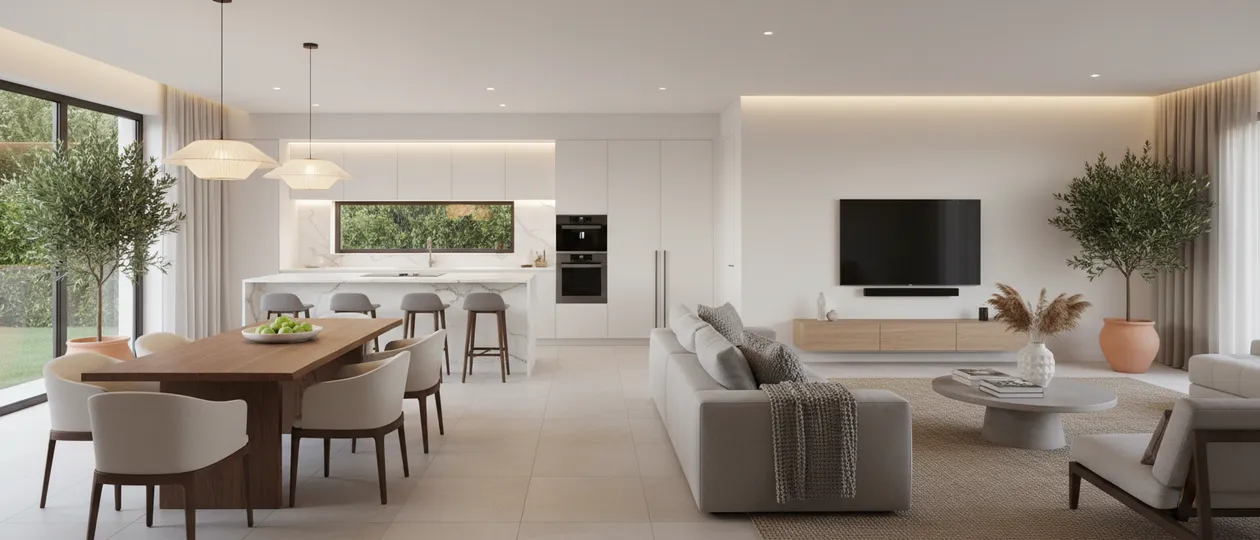
Open-plan living is one of the most popular renovation goals for homeowners. Knocking through walls to create a single flowing space — typically combining the kitchen, dining, and living areas — can transform how your home feels and functions. It lets in more natural light, makes entertaining easier, and can add significant value to your property.
But creating an open-plan space is not as simple as swinging a sledgehammer. It involves structural engineering, careful planning, and a clear understanding of how you actually use your home. Get it right, and you’ll wonder how you ever lived with all those walls. Get it wrong, and you’ll end up with an echoey, impractical space that’s expensive to heat.
This guide covers everything you need to know before, during, and after an open-plan renovation.
Why open-plan works — and when it doesn’t
Before committing to removing walls, be honest about whether open-plan living suits your household.
The benefits of open-plan living
- More natural light — removing walls allows light to travel deeper into the floor plan, reducing the need for artificial lighting during the day
- Better flow — cooking, eating, and relaxing happen in one connected space, making daily life feel less fragmented
- Easier supervision — parents can watch children while cooking or working
- Social cooking — the cook is no longer isolated in a separate room
- Perceived space — even if you don’t add square footage, removing walls makes a home feel significantly larger
- Added property value — open-plan kitchen-living spaces are consistently one of the most desirable features for buyers
The drawbacks to consider
- Noise travels — a blender, a television, and a homework conversation all compete in the same space
- Cooking smells spread — without a door to close, frying odours reach the sofa
- Less privacy — there’s nowhere to escape within the open area
- Heating costs — one large space can cost more to heat than several smaller rooms
- Clutter visibility — a messy kitchen is on permanent display
Who should think twice
Open-plan may not be ideal if:
- Multiple people work from home and need quiet space
- You have teenagers who need separate zones
- You cook frequently with strong-smelling ingredients and prefer a closed kitchen
- Your home has period features (cornices, fireplaces) that would be lost by removing walls
For many households, a broken-plan approach — using partial walls, glazed screens, or sliding doors — offers the best of both worlds. You get the openness when you want it and the ability to close off areas when you need privacy or quiet.
Structural considerations: the most important part
This is where open-plan renovations get serious. Walls in your home are either load-bearing (structural) or non-load-bearing (partition). You can remove a partition wall with minimal structural work. Removing a load-bearing wall requires a steel beam (or timber beam, depending on the loads) to carry the weight that the wall was supporting.
How to tell if a wall is load-bearing
You cannot reliably determine this yourself. However, these clues can give you an initial sense:
- Walls that run perpendicular to floor joists are often load-bearing
- Walls that sit directly above or below another wall on a different floor are more likely to be structural
- External walls are almost always load-bearing
- Walls in the centre of the house that run the length of the building are often structural spine walls
Do not rely on guesswork. Always hire a structural engineer to assess the wall before any demolition. This is non-negotiable — removing a load-bearing wall without proper support can cause floors to sag, cracks to appear throughout the house, and in the worst case, a partial collapse.
The structural engineering process
- Survey — a structural engineer visits your property, inspects the wall, checks the floor plan, and determines what loads the wall carries
- Calculations — the engineer calculates the required beam size (steel or timber) based on the span, the loads above, and the bearing points at each end
- Drawings — you receive structural drawings showing the beam specification, padstones or bearing plates, and any temporary support requirements
- Building control submission — the structural drawings are submitted to your local building control authority (or approved inspector) as part of your building regulations application
- Installation — your contractor installs temporary props, removes the wall, installs the beam, and makes good
Steel beam basics
The most common solution for domestic open-plan renovations is a steel beam (often called an RSJ — Rolled Steel Joist — in the UK, or an I-beam in the US). Key things to know:
- Size matters — beam size depends on the span (how wide the opening) and the load (what’s above). Longer spans and heavier loads need bigger beams.
- Bearings — the beam needs solid support at each end. This usually means concrete padstones or steel bearing plates sitting on adequate masonry or new structural supports.
- Concealment — beams can be left exposed (industrial look), boxed in with plasterboard/drywall, or recessed into the floor above if there’s sufficient depth.
- Cost — a typical domestic steel beam with installation costs $1,500-$5,000 / GBP 1,200-GBP 4,000, depending on size, access, and complexity. The structural engineer’s fees are additional (typically $500-$1,500 / GBP 400-GBP 1,200).
Other structural elements to watch for
- Chimney breasts — these often carry the weight of the chimney stack above. Removing them requires structural support for whatever remains above.
- Floor level changes — older homes may have different floor levels between rooms. Levelling floors adds cost and complexity.
- Services in the wall — walls often contain electrical wiring, plumbing pipes, gas lines, or heating ducts. These need to be rerouted before demolition.
- Party walls — if the wall you want to remove is shared with a neighbour (terraced/townhouse), you’ll need a party wall agreement. This is a legal requirement in many jurisdictions and adds both time and cost.
Planning permission, building permits, and regulations
Most internal wall removals do not require planning permission (UK) or zoning approval (US). However, they almost always require building regulations approval (UK) or a building permit (US).
What typically requires building control approval
- Removing or altering any load-bearing wall
- Any structural work that changes how loads are transferred through the building
- Changes to fire escape routes (particularly in flats/apartments or multi-storey properties)
- Electrical work associated with the renovation (in many jurisdictions)
- Changes to drainage or plumbing runs
What typically does NOT require approval
- Removing a simple non-load-bearing partition wall (though it’s wise to confirm with building control first)
- Cosmetic changes within the new space
Listed buildings and heritage properties
If your home is listed (UK) or in a historic district (US), additional approvals may be needed. Listed building consent is a separate process from planning permission, and removing internal walls in a listed building often requires it — even if the wall isn’t structural.
The cost of non-compliance
Skipping permits might save a few hundred dollars or pounds upfront, but it creates serious problems later:
- Building control can require you to undo the work at your expense
- Your home insurance may be invalidated
- When you sell, buyers’ solicitors/attorneys will ask for building control sign-off. Missing paperwork can delay or derail a sale.
- Mortgage lenders may refuse to lend against a property with unapproved structural work
Always get the proper approvals. Your structural engineer and contractor should guide you through this process.
Designing your open-plan layout
Once you know what’s structurally possible, the fun part begins — deciding how to use the space.
Zone your space
A successful open-plan room works because it’s not one big undefined area. It has distinct zones for different activities:
- Cooking zone — the kitchen, with its worktops, appliances, and storage
- Dining zone — a table and chairs, ideally close to the kitchen for easy serving
- Living zone — comfortable seating, television, bookshelves
- Optional zones — a homework/study area, a reading nook, a play corner
Techniques for defining zones
You don’t need walls to create distinct areas. Effective zoning techniques include:
- Kitchen island or peninsula — the most popular way to define the boundary between kitchen and living space. It provides additional worktop space, storage, and informal seating.
- Floor material changes — tile in the kitchen zone transitioning to timber or carpet in the living zone. Use a flush threshold strip for a clean join.
- Ceiling height changes — a dropped ceiling over the kitchen can subtly define the zone. This also provides a convenient space to run extractor ducting.
- Rugs — a large rug under the sofa and coffee table anchors the living zone within the larger space.
- Furniture arrangement — the back of a sofa facing the kitchen naturally divides the room.
- Lighting changes — pendant lights over the dining table, task lighting in the kitchen, ambient lighting in the living area. Different lighting sets different moods in each zone.
- Partial walls or columns — a half-height wall or a structural column left in place can act as a natural divider without blocking sightlines.
Layout principles
- The working triangle still applies in the kitchen zone — keep the sink, hob/cooktop, and refrigerator within easy reach of each other
- Place the dining table between kitchen and living zones — it acts as a natural buffer
- Face the sofa away from the kitchen — this lets people in the living zone relax without staring at dirty dishes
- Consider sight lines from the entrance — what’s the first thing you see when you walk in? Make it the best part of the room, not the bin or the laundry pile.
- Plan for power — you’ll need electrical outlets in every zone. Floor outlets can be useful for island units and centrally-placed lamps.
Ventilation and extraction
This is the detail that many homeowners overlook — and then regret.
An open-plan kitchen-living space needs excellent extraction to prevent cooking smells, steam, and grease from permeating the entire room. Your options:
Extractor hoods
- Wall-mounted or chimney hoods — traditional and effective, mounted above the hob/cooktop against a wall
- Island hoods — suspended from the ceiling above an island hob. These need to be more powerful because they don’t have a wall to channel air.
- Downdraft extractors — built into the worktop beside the hob. These rise up when in use and retract when not needed. They look sleek but are generally less effective than overhead extraction.
- Ceiling extractors — integrated into the ceiling above the hob. Visually minimal but require ducting through the ceiling void.
Key specifications
- Extraction rate — your extractor should be able to change the air in the kitchen zone 10-15 times per hour. For a kitchen zone of roughly 30 square metres (320 square feet) with 2.4m (8ft) ceilings, that means an extraction rate of around 700-1,000 cubic metres per hour.
- Ducted vs recirculating — ducted extraction (vented to the outside) is significantly more effective than recirculating. Always duct to outside if possible.
- Noise — extractors in open-plan spaces need to be quiet enough that people in the living zone aren’t disturbed. Look for models rated below 60 dB at normal speed.
Acoustics and noise control
Sound is the hidden challenge of open-plan living. Hard surfaces (tile floors, glass, plasterboard/drywall) reflect sound, creating echo and making the space feel noisy.
Strategies for managing sound
- Soft furnishings — upholstered furniture, curtains, cushions, and rugs all absorb sound
- Acoustic panels — decorative wall panels made from sound-absorbing material can reduce echo without looking industrial
- Bookshelves — a full bookshelf is an excellent sound absorber
- Ceiling treatment — acoustic ceiling tiles or panels in the kitchen zone can reduce noise from extraction fans and cooking
- Underfloor heating — eliminates radiators (which reflect sound) and allows you to use rugs without worrying about blocking heat output
- Zoned speaker systems — if you want music in the kitchen and television in the living area, invest in a multi-room audio system rather than turning everything up to compete
Heating an open-plan space
Removing walls changes how heat moves through your home. You may need to rethink your heating strategy.
Common approaches
- Underfloor heating (UFH) — ideal for open-plan spaces. It heats evenly from below, works well with hard floors, and eliminates wall-mounted radiators that interrupt the open layout. UFH can be wet (connected to your boiler/furnace) or electric (simpler to install but more expensive to run).
- Larger radiators — if sticking with radiators, you’ll likely need larger ones to compensate for the increased volume of the combined space. A heating engineer can calculate the required output.
- Zoned heating controls — consider separate thermostatic controls for the kitchen zone and living zone. Cooking generates heat, so the kitchen zone often needs less heating than the living area.
- Improved insulation — if you’re opening up the space, it’s a good time to upgrade insulation in the external walls and floor. Better insulation reduces ongoing heating costs for the larger space.
Costs: what to expect
Open-plan renovation costs vary enormously depending on the structural work required, the size of the space, and the level of finish. Here’s a realistic breakdown.
Structural work only (wall removal + beam)
| Item | Typical cost range |
|---|---|
| Structural engineer fees | $500-$1,500 / GBP 400-GBP 1,200 |
| Steel beam (supply and install) | $1,500-$5,000 / GBP 1,200-GBP 4,000 |
| Building control/permit fees | $200-$800 / GBP 200-GBP 600 |
| Making good (plastering, decorating) | $1,000-$3,000 / GBP 800-GBP 2,500 |
| Total structural work | $3,200-$10,300 / GBP 2,600-GBP 8,300 |
Full open-plan renovation (structural + new kitchen + flooring + decoration)
| Budget tier | Typical total cost |
|---|---|
| Budget | $25,000-$45,000 / GBP 20,000-GBP 35,000 |
| Mid-range | $45,000-$80,000 / GBP 35,000-GBP 65,000 |
| Premium | $80,000-$150,000+ / GBP 65,000-GBP 120,000+ |
These figures include the structural work, a new kitchen, new flooring throughout the open-plan area, lighting, decoration, and associated electrical and plumbing work. They do not include furniture or appliances.
What drives costs up
- Longer beam spans — wider openings need larger (more expensive) beams and potentially more complex support arrangements
- Basement or ground floor with rooms above — heavier loads above mean bigger beams
- Chimney breast removal — adds structural complexity and cost
- Floor levelling — if the rooms being combined have different floor levels, levelling adds $1,000-$5,000 / GBP 800-GBP 4,000
- Service diversions — rerouting gas, water, or electrical services that run through the wall being removed
- Access difficulties — getting a large steel beam into a terraced house through narrow corridors or up stairs
Common mistakes to avoid
Having seen hundreds of open-plan renovations, contractors consistently flag the same mistakes:
- Not hiring a structural engineer — this is the one professional you absolutely must use. No exceptions, no shortcuts.
- Underestimating extraction needs — a cheap extractor fan will not cope. Invest in proper kitchen extraction or you’ll regret it every time you fry something.
- Forgetting about storage — removing a wall often means losing cupboard or shelf space that was against it. Plan replacement storage before demolition.
- Ignoring acoustics — the echo problem only becomes apparent after the wall is gone, when it’s expensive to fix.
- No electrical planning — think about where you need outlets, light switches, and data points before the plastering is done. Adding them later means cutting into new walls.
- Skipping the broken-plan option — full open-plan isn’t always better. Consider glazed partitions, pocket doors, or half-height walls that give you flexibility.
- Not considering resale — in some markets, buyers prefer a separate kitchen. A fully open-plan layout that can’t easily be reversed may limit your buyer pool.
Step-by-step process for your open-plan renovation
Here’s the practical sequence of steps from idea to completion:
- Define your goals — why do you want open-plan? What activities will happen in the space? Read our guide to planning a home renovation for a thorough approach.
- Write a project brief — document what you want, including your layout preferences, budget, and must-haves. A clear scope of work helps contractors quote accurately. Our guide on how to write a renovation project brief walks you through this.
- Hire a structural engineer — get the wall assessed and the beam designed before approaching contractors.
- Get quotes — approach at least three contractors with your brief and structural drawings. Compare their quotations carefully.
- Apply for building control/permits — your contractor or structural engineer can usually handle this.
- Agree the contract — nail down the scope of work, timeline, payment schedule, and how change orders will be handled.
- Strip and demolish — temporary supports go in, the wall comes out, the beam goes in.
- First fix — electrical, plumbing, and heating rough-in for the new layout.
- Second fix and finishes — plastering, flooring, kitchen installation, painting, lighting.
- Snagging — do a thorough snagging inspection before making the final payment.
Ready to plan your open-plan renovation?
Creating an open-plan living space is one of the most transformative things you can do to a home. But it takes careful planning to get right — from structural engineering to layout design to the details of ventilation and acoustics.
The key is starting with a clear brief that captures what you want, so contractors can give you accurate quotes and realistic timelines.
Join our early access to be the first to try Aikitektly — our free AI-powered renovation planning tool that helps you describe your project clearly and professionally, so you can approach contractors with confidence.